
English| EUR
Suggested for you
More currencies
Choose a language
The Motovun Forest yields two truffle varieties across nine months of the year, each following a distinct growing cycle tied to soil temperature and rainfall. White truffles command the autumn calendar, while black truffles bookend the season in spring and winter. Timing your visit to the right window determines which species you'll encounter and what forest conditions your guide's dog will work in.
Quick answer
The motovun truffle hunting season runs from September through late January for prized white truffles (Tuber magnatum), with peak aroma and size occurring in October and November. Black winter truffles (Tuber melanosporum) fruit from December through March, while the smaller black summer truffle appears May through August. Most truffle hunting tours operate year-round, but autumn offers the coolest temperatures, the most aromatic specimens, and the highest success rates for finding mature tubers in the Mirna Valley's oak and hazel groves.
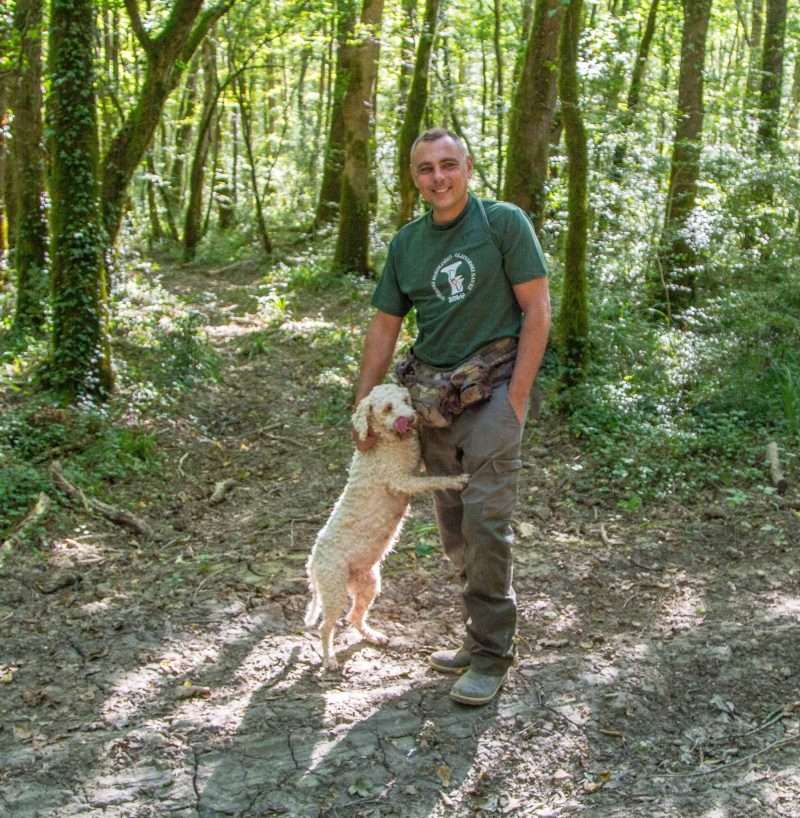
A single kilogram of white truffle from the Motovun Forest sold for €4,200 at the 2025 Livade truffle fair, triple the price of black winter specimens harvested the same week. That premium reflects both scarcity and a narrow harvest window: Tuber magnatum develops its signature aroma only when soil temperatures drop below 15°C and autumn rains saturate the clay-limestone substrate beneath oak roots. The motovun truffle hunting season for white truffles spans roughly sixteen weeks, but the eight-week stretch from early October to late November accounts for seventy percent of the annual yield by weight. Black truffles follow a longer, split calendar. Tuber melanosporum, the winter species prized by Michelin kitchens, fruits from December through March, overlapping the tail end of white truffle season and continuing after the last Tuber magnatum is pulled from the ground. Its growing cycle tolerates colder soil, and trained dogs locate mature specimens even when January frost hardens the forest floor. The unrelated black summer truffle, Tuber aestivum, appears in the same root zones from May through August but carries a milder scent and a fraction of the culinary value—guides rarely dedicate morning excursions to it outside the truffle festival circuit. Truffle hunting in Istria remains a private-land activity governed by concession: the Motovun Forest is open to walkers, but harvesting tubers without a licensed guide violates regional agriculture law. Tours depart from the lower forest edge near the Mirna riverbank, where oak density peaks and decades of dog work have mapped productive root networks. Autumn bookings fill by late August; the same guides who lead October white-truffle excursions switch to black winter truffles in January, working the same groves under different soil conditions. Each hunt lasts two to three hours, timed to the early morning window when cooler air keeps the dogs sharp and ground scent concentrated. The forest itself operates no ticketing or access fees—the zero-euro entrance reflects its status as municipal common land—but every truffle hunt requires a paid guide with a trained Lagotto Romagnolo. Dogs work the root line by scent, stopping to paw when they locate a mature truber six to twelve centimeters below the surface. The guide excavates by hand, leaving the root structure intact to preserve future yields. What you find stays with the guide; what you learn and photograph is yours. Most tours include tasting and purchase options at the guide's home kitchen, where fresh specimens are shaved over pasta or scrambled eggs within an hour of harvest. Seasonal timing shapes more than availability: October truffles weigh thirty to sixty grams on average, twice the size of late-season specimens, and their aroma compounds degrade within five days of harvest. A November hunt offers the intersection of size, scent intensity, and stable weather. December and January pivots the experience toward black truffles, a longer shelf life, and snow-dusted forest light that changes how the landscape photographs but not how the dogs work.
“October truffles weigh thirty to sixty grams on average, twice the size of late-season specimens, and their aroma compounds degrade within five days of harvest.”
Truffle hunting in the Motovun Forest spans the entire year, with distinct seasons for black and white varieties. Visiting during the transition months provides the most balanced experience for tracking scent conditions.
Warm, turning to cool and damp
The peak season for white truffles begins in September, attracting more visitors.
Cold and frequent rainfall
This period focuses on various black truffle species, offering quieter forest conditions.
Cool, optimal for scent tracking
Arriving between 08:00 and 10:00 maximizes dog performance and maintains forest solitude.
Verdict: Tuesday to Thursday, arriving between 08:00 and 10:00, during the white truffle season in October.
The Motovun Forest remains accessible daily to facilitate truffle hunting excursions. These operational hours ensure consistent scheduling opportunities throughout the hunting season.
Access to the Motovun Forest is open to the public without an entrance fee. Participation in organized truffle hunting activities requires booking a professional tour, as private foraging is regulated.
Verdict: While the forest has no entrance fee, visitors typically pay for professional guided services to engage in truffle hunting.
Truffle hunting in Motovun requires advance booking through licensed guides, as the forest is open to the public but the activity itself is private. Plan to arrange your tour at least a week ahead during peak autumn season.
Book your tour directly with a guide
Confirm the meeting time and location
Dress for forest terrain and weather
Arrive at the agreed meeting point
Follow the guide's instructions during the hunt
The Motovun Forest is located within the Mirna Valley, accessible primarily by road. Most visitors reach the area by private vehicle or taxi from nearby Istrian towns.
A9 motorway toward Višnjan, then follow signs for Motovun/Livade
Direct transfer from Poreč or Umag
From Motovun town center via marked forest trails
For optimal scent conditions and canine performance, coordinate your arrival between 08:00–10:00. Follow the address at Motovun Forest, Mirna Valley, 52424 Motovun, Croatia.
Follow these practical recommendations to ensure a successful and respectful experience in the Motovun Forest.
Wear waterproof hiking boots with deep treads as the Mirna Valley floor remains damp and muddy even on sunny days. Avoid sneakers to prevent slipping on uneven terrain and riverbank sediment.
Do not pet or distract the truffle-hunting dogs while they are actively searching. Allow them to maintain focus on their training and scent detection tasks during the hunt.
Dress in long-sleeved, lightweight synthetic layers to protect against dense undergrowth and seasonal insects. Neutral colors are preferred to avoid startling the animals that inhabit the forest area.
Keep camera gear and personal items secured in a crossbody bag or secure pack. This leaves your hands free to navigate narrow forest trails and prevents items from snagging on low-hanging branches.
Stick strictly to the paths established by your guide to protect the sensitive fungal mycelium networks in the soil. Refrain from picking any vegetation, as the forest ecosystem is strictly regulated and protected.
Everything you need to know about motovun truffle hunting season
The forest environment supports truffle hunting throughout the year, though peak activity often centers around the discovery of white and black truffles. Seasonal availability varies, so visitors should plan accordingly based on current forest conditions. Consulting the official tourism board website provides the most accurate information on current harvests. Local guides facilitate these excursions to ensure visitors find the best locations during the motovun truffle hunting season.
Participating in a professional forest excursion requires booking a private tour with authorized local experts. These tours provide the necessary dogs and equipment to locate the fungi beneath the soil. Visitors should arrive prepared for uneven forest terrain and outdoor conditions. All activities are coordinated through local providers to ensure adherence to sustainable practices.
Entry to the forest itself is 0 EUR. While there is no fee for the forest access, private tours conducted by experts require payment to cover the professional services and dog handlers provided. Information on these services can be found via the official tourism portal.
The best arrival window for your visit is between 08:00 and 10:00. This timeframe provides cooler forest temperatures which helps the trained dogs maintain their scent-tracking effectiveness. Arriving early ensures a better experience in the Mirna Valley environment.
Yes, families are generally welcome to join these outdoor educational experiences. It is advised to check with specific tour providers regarding age suitability and accessibility requirements for younger guests. These outings offer an educational look at the local woodland ecosystem.
Yes, you must book a private tour to participate in the hunt. Authorized guides are essential for navigating the forest and utilizing trained dogs to find the truffles. Attempting to harvest without professional accompaniment is not permitted.