English| EUR
Suggested for you
More currencies
Choose a language
Truffle hunting in Motovun is a field practice in which trained dogs lead foragers through oak and hazelnut groves to locate subterranean fungi prized for their culinary value. The tradition has anchored Istrian culture for generations, and private operators now offer guided outings that pair forest ecology with live demonstration. This page explains how the hunt works, what tools and skills define it, and how visitors can participate.
Quick answer
Truffle hunting is the practice of using scent-trained dogs to locate wild truffles buried beneath forest soil, typically in oak and hazelnut woodlands. Motovun's truffle dogs—usually Lagotto Romagnolo or mixed-breed hounds—undergo months of conditioning to distinguish truffle aroma from other organic matter. Hunts occur year-round, though autumn and winter yield the highest concentrations of white truffles, while spring and summer favor black varieties. Most outings last two to three hours and include forest walking, soil excavation by the handler, and on-site tasting.
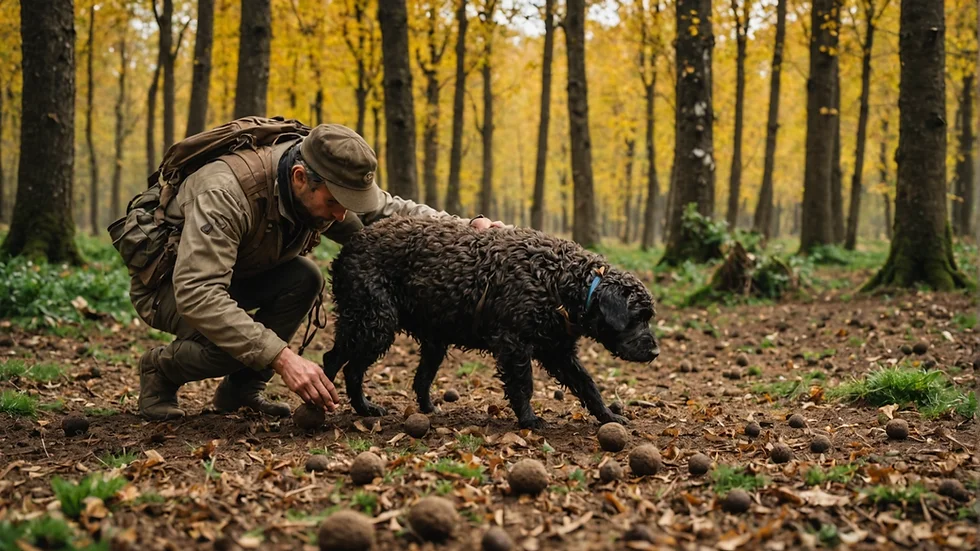
A truffle dog in Motovun Forest moves in tight arcs, nose low, reading scent trails invisible to human senses. When the dog halts and begins to paw at a patch of leaf litter, the handler kneels, brushes debris aside, and uses a narrow spade to lift soil in careful increments until a rough-skinned tuber appears. That sequence—search, signal, excavation—is what is truffle hunting in its operational form. The practice relies on biological partnership. Truffles grow symbiotically with tree roots and release volatile compounds as they mature. Dogs bred or trained for the work can detect those compounds through several centimeters of compacted earth. Handlers reward each find with food or play, reinforcing the behavior. The Lagotto Romagnolo, an Italian water dog, is the breed most commonly associated with truffle work in Istria, though mixed-breed hounds trained from puppyhood perform equally well. Training begins as early as two months and continues for six to twelve months before a dog is considered field-ready. Motovun's terrain—rolling hills covered in mixed deciduous forest—provides the moisture, alkaline soil, and symbiotic host trees that truffles require. White truffles, the more aromatic and commercially valuable species, fruit from October through January. Black truffles appear from May through September. Foragers read forest signs: canopy density, understory vegetation, mycorrhizal health. A single hillside may yield nothing, while a neighboring grove produces several dozen specimens in an hour. That variability is intrinsic to truffle ecology and makes each outing unpredictable. Guided truffle hunts in the Motovun area are booked privately with individual operators rather than through a central venue. Most include forest access, handler narration, dog demonstration, and a tasting of preserved or fresh truffle with local bread and olive oil. Participants walk uneven ground and should expect mud, low branches, and variable weather. The forest itself is open year-round at no cost, but the expertise, trained animal, and land-use permissions that define a truffle hunt are provided only by licensed foragers. What is truffle hunting, operationally, is knowledge passed across generations and now made accessible to outsiders willing to rise early and follow a dog into the trees.
“A truffle dog in Motovun Forest moves in tight arcs, nose low, reading scent trails invisible to human senses.”
The optimal time to visit the Motovun Forest for truffle hunting is between 08:00 and 18:00, which provides the best natural light for navigating the terrain and aligns with the peak activity periods of trained truffle dogs.
Optimal light conditions
Arriving between 08:00 and 18:00 ensures visibility and energetic working conditions for dogs.
Cooler, damp, 10°C to 18°C
This period marks the height of the white truffle harvest, drawing the most interest from visitors.
Mild, 12°C to 20°C
The forest is active for black truffles, offering a more secluded environment for participants.
Verdict: For the most productive experience, plan your visit for the morning hours between 08:00 and 18:00 during the active harvesting months of October or April.
The Motovun Forest remains accessible to visitors throughout the week, providing round-the-clock entry to the grounds. While the forest is technically open at all hours, logistical planning remains necessary for those engaging in organized activities.
Access to the Motovun Forest is unrestricted for the public. Costs only arise when engaging professional truffle hunting services provided by private operators.
Verdict: The forest entrance is free, while the cost of a truffle hunting experience is determined by the specific private operator selected.
The Motovun Forest is located in the Mirna River valley in Istria, Croatia. Access is primarily achieved by private vehicle, as the forest is situated at the base of the Motovun hill.
Follow road D44 toward Motovun and turn onto local forest access roads
Direct transfer from Motovun town center or nearby Istrian towns
From the base of Motovun hill into the Mirna River valley
For those driving, park in designated areas near the base of the Motovun hill before proceeding to your meeting point. Following your operator's specific coordinates for the forest entrance is essential, as public forest tracks are not always marked for general traffic.
Truffle hunting in Motovun follows a straightforward progression from advance booking through a guided forest walk with trained dogs. Most experiences last 2–3 hours from arrival to departure.
Contact a truffle-hunting guide or estate in advance—most require reservations at least 24 hours ahead, and peak autumn weeks fill early. Confirm the meeting location, as some operators gather at forest trailheads rather than in town.
Plan to meet your guide between 08:00 and 18:00 when forest light is optimal and dogs are most active. Wear closed-toe shoes with grip; the forest floor is uneven and can be damp even in summer.
Your guide will lead a trained Lagotto Romagnolo or mixed-breed dog along known truffle zones. Stay a few paces behind—dogs work best without crowding, and handlers signal when they've detected a scent change.
When the dog indicates a find by pawing or sitting, the handler carefully unearths the truffle with a small spade or pick. You'll see how depth, soil type, and root proximity determine quality.
Most guides conclude the walk with a tasting of fresh truffle shavings, often paired with bread, cheese, or olive oil. This is the moment to ask about preparation techniques and seasonal differences in aroma.
Successful truffle hunting in the Motovun Forest relies on proper preparation and respect for the specialized working relationship between the hunter and their dog.
Wear waterproof hiking boots with deep treads, as the Motovun Forest floor remains damp and slippery even during dry spells. Avoid open-toed shoes to protect against thorns and mud.
Maintain distance from the working dogs and never attempt to pet or feed them without explicit permission from the handler. Distractions can disrupt their focus and scent tracking abilities.
Keep noise levels to a minimum during the hunt to allow the dog to concentrate on the handler's commands and forest sounds. Sudden loud noises can cause the dog to lose interest or become anxious.
Refrain from touching or moving excavated earth after a dog marks a spot. The hunter uses these specific marks to assess the maturity of the truffle.
Carry a personal water supply and keep insect repellent in your pack, as the humid forest environment attracts mosquitoes and ticks. Layered clothing is recommended to adjust for temperature shifts under the dense tree canopy.
Everything you need to know about what is truffle hunting
In the Motovun Forest, this practice involves searching for subterranean fungi using specially trained dogs that detect the scent of the Tuber magnatum. It is a traditional Istrian activity that highlights the region's culinary heritage and rich oak woodland ecosystem. Understanding what is truffle hunting requires witnessing the unique bond between the handler and their canine partner as they navigate the forest floor. The process is a quiet, observation-focused experience centered on the search for these aromatic delicacies.
While the forest itself is open to the public for free, what is truffle hunting typically requires a private booking with a specialized local operator. These independent professionals provide access to expertise, equipment, and trained dogs. Visitors should arrange these sessions in advance to ensure a structured and educational outing.
The best time for this activity is between 08:00 and 18:00, which offers optimal light for walking and higher activity levels for the dogs. This window is ideal for exploring the Motovun Forest while ensuring comfortable conditions for both participants and animals. Planning your excursion during these hours maximizes the likelihood of a successful and pleasant walk.
Yes, since the forest is a protected environment and the process requires specific knowledge, you must book with a professional operator. These experts know the terrain and possess the necessary permits and trained animals to conduct the search effectively. Engaging a professional ensures you gain insight into what is truffle hunting while respecting the local conservation rules.
Yes, this outdoor activity can be a rewarding educational experience for families who enjoy nature walks. It provides a unique opportunity to observe working dogs in action while learning about the ecology of the Motovun region. Please ensure your booking provider is aware of the ages of participants to tailor the pace of the excursion accordingly.
This practice is a collaborative process where the dog leads the human through the forest, sniffing out mature fungi buried beneath the soil. Once the dog signals a discovery, the handler carefully uses a specialized spade to extract the find without damaging the root system. It is a fascinating display of animal intelligence that defines the essence of the experience.